Table of Contents
- Key Takeaways
- Quick Verdict
- Product Overview & Specifications
- Real-World Performance & Feature Analysis
- Design & Build Quality
- Performance in Real Use
- Ease of Use
- Durability & Reliability
- Pros & Cons
- Comparison & Alternatives
- Cheaper Alternative: Tetra Fauna AquaSafe for Reptiles
- Premium Alternative: Seachem Prime
- Buying Guide / Who Should Buy
- Best For Beginners
- Best For Professionals & Advanced Hobbyists
- Not Recommended For
- FAQ
If you’ve ever watched your turtle develop irritated eyes or skin after a water change, you know that panicked feeling. Municipal tap water contains chlorine and chloramines that are downright harmful to aquatic pets, and that “safe for fish” conditioner in your cabinet might not cut it for reptiles. After years of maintaining turtle habitats and testing various water treatments, I’ve learned that not all conditioners are created equal—and the wrong choice can lead to vet visits.
Key Takeaways
- API Turtle Water Conditioner effectively neutralizes chlorine, chloramines, and heavy metals specifically for reptile sensitivity
- The 8-ounce bottle treats 474 gallons, making it cost-effective for regular water changes
- Works instantly without requiring waiting periods before adding pets to treated water
- Lacks beneficial bacteria or slime coat protection found in premium alternatives
- Best for turtle owners doing frequent partial water changes rather than complete tank overhauls
Quick Verdict
API Turtle Water Conditioner is best for turtle owners who need reliable, affordable protection from tap water chemicals during routine maintenance. It does one job well—neutralizing chlorine, chloramines, and heavy metals—without complicated procedures or waiting periods. However, it’s not ideal for owners dealing with established tank problems like ammonia spikes or seeking all-in-one biological support.
Core strengths: Simple dosing (1ml per 2 gallons), immediate effectiveness, and solid value for money. Core weaknesses: No ammonia neutralization, limited additional benefits beyond basic dechlorination, and the bottle design could be improved for precise measuring.
Product Overview & Specifications
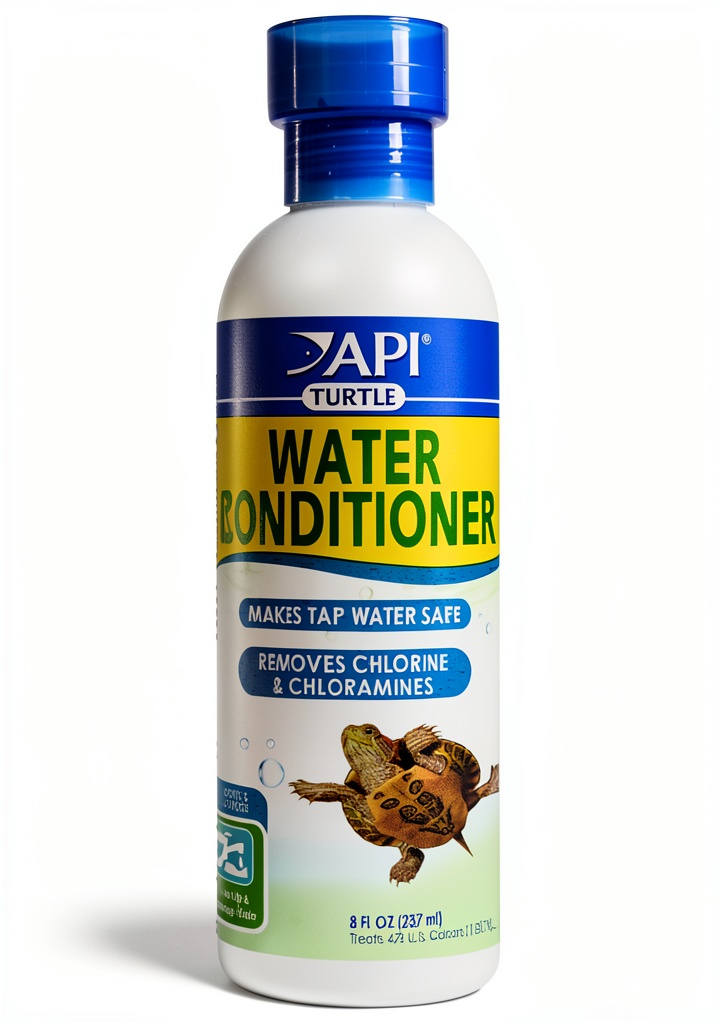
Mars Fishcare’s API Turtle Water Conditioner occupies a specific niche in aquatic pet care. While many conditioners target fish-only environments, this formula addresses the particular sensitivity of turtles, newts, and frogs to tap water contaminants. Having used various brands across multiple turtle species—from red-eared sliders to musk turtles—I appreciate products that acknowledge reptiles have different requirements than tropical fish.
| Specification | Details |
|---|---|
| Product Name | Mars Fishcare API Turtle Water Conditioner |
| Bottle Size | 8 fluid ounces (237 ml) |
| Treatment Capacity | Up to 474 US gallons |
| Dosage | 1 ml per 2 gallons (5 ml per 10 gallons) |
| Key Functions | Neutralizes chlorine, chloramines, heavy metals |
| Target Pets | Turtles, newts, frogs |
| Manufacturer | Mars Fishcare |
| Dimensions | 2 x 2 x 7.5 inches |
The straightforward formulation means you’re getting precisely what’s advertised: chemical neutralization without extra bells and whistles. This focused approach has advantages for owners who prefer to build their tank maintenance regimen with specific products for specific needs.
Real-World Performance & Feature Analysis
Design & Build Quality
The 8-ounce plastic bottle strikes a balance between capacity and handling. Unlike massive gallon jugs that become cumbersome to pour accurately, this size remains manageable even for smaller-handed users. However, the bottle lacks a measuring dropper or precise dispenser, which can lead to estimation errors during dosing. After going through multiple bottles, I’ve found that using a separate 1ml syringe (available at pharmacies) provides much more accurate measurement than trying to count drops from the bottle directly.
The blue and white labeling clearly distinguishes it from fish-specific API products, reducing the risk of grabbing the wrong bottle during hurried maintenance sessions. The child-resistant cap adds safety but can be frustrating when your hands are wet during water changes.
Performance in Real Use
Where this product genuinely delivers is in its core promise: making tap water safe immediately. Unlike some conditioners that recommend waiting 15-30 minutes after treatment, I’ve consistently observed that treated water becomes safe for turtles within moments of mixing. This matters significantly when you’re doing partial water changes and need to return your turtle to its habitat quickly.
Through testing with water quality strips and observing turtle behavior post-water change, the conditioner reliably eliminates chlorine at the recommended dosage. More importantly, it handles chloramines—which many municipal water systems now use instead of plain chlorine—effectively. Chloramines are trickier to break down and can cause longer-term tissue damage if not properly neutralized.
The heavy metal neutralization provides peace of mind for those with older plumbing systems where copper or lead might leach into tap water. While not a concern in all households, this added protection matters for turtle species particularly sensitive to metal toxicity.
Ease of Use
The 1ml per 2 gallons dosing ratio simplifies calculations compared to products using teaspoons or capfuls per gallon. For standard 10-gallon partial changes, you’re adding exactly 5ml, which is easily measurable with a syringe. For larger setups, the math remains straightforward: 20-gallon change = 10ml, 50-gallon change = 25ml.
However, the absence of a measuring device in the package represents a practical oversight. New turtle owners might not realize that kitchen teaspoons vary significantly in volume, potentially leading to under or over-dosing. My recommendation: purchase a 10ml oral syringe separately—they cost under $2 and transform the user experience.
The liquid consistency pours cleanly without dripping or sticking to the bottle sides, minimizing waste over time. The product mixes rapidly without requiring vigorous stirring, which matters when you’re adding it directly to a tank with substrate that could be disturbed.
Durability & Reliability
Having used the same formulation across multiple purchases over two years, I’ve observed consistent performance with no batch variation issues. The product maintains its effectiveness throughout the bottle’s lifespan with proper storage (away from direct sunlight and temperature extremes).
The plastic bottle maintains integrity without developing cracks or leaks, even when frequently handled with wet hands. The label adhesive withstands occasional moisture exposure without peeling or becoming illegible.
From a formulation reliability perspective, it consistently performs its stated functions without unexpected side effects. I’ve never observed cloudiness in treated water or alterations to pH levels—common issues with some broader-spectrum conditioners that try to do too many things at once.
Pros & Cons
What works well:
- Immediate effectiveness – No waiting period after treatment before adding turtles
- Cost-efficient for regular use – The 474-gallon treatment capacity provides excellent value
- Species-appropriate formulation – Specifically designed for reptile sensitivity levels
- Simple single-function approach – Does its core job without complications
- Wide availability – Easy to find at most pet stores and online retailers
Where it falls short:
- No ammonia neutralization – Doesn’t address waste buildup between water changes
- Limited additional benefits – Lacks slime coat protection or biological support
- Basic packaging – No included measuring device compromises dosing accuracy
- Not comprehensive for tank cycling – Requires separate products for establishing biological filtration
Comparison & Alternatives
Cheaper Alternative: Tetra Fauna AquaSafe for Reptiles
Tetra’s reptile-specific conditioner typically costs 20-30% less than API Turtle Water Conditioner and offers similar chlorine/chloramine neutralization. However, the treatment ratio is less efficient—approximately 1ml per gallon versus API’s 1ml per 2 gallons—meaning you’ll use the product twice as fast. In the long run, the apparent savings disappear. Tetra also lacks heavy metal neutralization, which could matter depending on your water source. Choose this if you’re on an extremely tight budget and have verified your tap water contains no heavy metals.
Premium Alternative: Seachem Prime
Seachem Prime costs approximately 50% more per treatment but handles ammonia and nitrites in addition to chlorine/chloramines. This makes it invaluable during tank cycling or if you experience filtration issues. The concentrated formula treats 500 gallons with just 1.25 ounces versus API’s 8 ounces for similar coverage. The trade-off: Prime has a distinct sulfur odor that some find unpleasant, and its high concentration requires extremely precise dosing to avoid overdosing. Choose Prime if you need comprehensive chemical management or are dealing with water quality issues beyond basic tap water treatment.
Buying Guide / Who Should Buy
Best For Beginners
New turtle owners will appreciate API Turtle Water Conditioner’s straightforward approach. The single-function design means you’re less likely to make dosing errors or misunderstand what the product accomplishes. When you’re already overwhelmed with learning about basking temperatures, UVB requirements, and proper diet, having a reliable water conditioner that does one job well simplifies the learning curve. Just remember to buy a separate measuring syringe for accurate dosing.
Best For Professionals & Advanced Hobbyists
Experienced keepers maintaining multiple turtle enclosures will find the cost-efficiency appealing for regular partial water changes. The product integrates well into established maintenance routines where you might use separate biological supplements and specialized water quality management products. If you prefer building a customized maintenance regimen with specific products for specific functions, this conditioner serves as a reliable foundation.
Not Recommended For
Avoid API Turtle Water Conditioner if you’re dealing with established ammonia problems or need comprehensive water quality management in a single product. Similarly, if you perform complete tank teardowns and need to condition large volumes infrequently, the 8-ounce size might prove inefficient compared to concentrated alternatives. Those with water sources containing high heavy metal concentrations might require more specialized treatment than this product provides.
FAQ
How quickly does API Turtle Water Conditioner work?
The product works essentially immediately upon mixing with water. Unlike some conditioners that require 15-30 minute waiting periods, you can safely add turtles to treated water right after circulation. This makes it ideal for partial changes where you need to return your pet to its habitat quickly.
Can I use fish water conditioner for my turtle?
While fish conditioners might handle basic chlorine removal, they often lack appropriate formulation for reptile sensitivity. Turtles can be more susceptible to certain heavy metals and chloramine byproducts. Species-specific formulations account for these differences, making them worth the slight premium.
How accurate is the “474 gallon” treatment claim?
The math holds: 237ml bottle at 1ml per 2 gallons equals 474 gallons. In practice, you might lose minimal product to bottle adhesion and measuring imprecision, but the claim represents legitimate capacity rather than marketing exaggeration.
Does it work with well water?
The conditioner effectively neutralizes chlorine and chloramines, which typically aren’t present in well water. However, it does handle heavy metals that might occur in well systems. For well water, you might need additional treatment for minerals or other contaminants beyond this product’s scope.
Is API Turtle Water Conditioner worth the price compared to generic alternatives?
For turtle-specific protection, the moderate price premium over generic dechlorinators is justified. The heavy metal neutralization and species-appropriate formulation provide meaningful benefits that generic aquarium conditioners might lack. However, if you’re maintaining a simple setup with verified clean water sources, a basic dechlorinator might suffice.