Table of Contents
- Key Takeaways
- Quick Verdict
- Product Overview & Specifications
- Real-World Performance & Feature Analysis
- Design & Build Quality
- Performance in Real Use
- Ease of Use
- Durability & Reliability
- Pros & Cons
- Comparison & Alternatives
- Cheaper Alternative: Pure Solar Salt
- Premium Alternative: Seachem Stress Guard
- Buying Guide / Who Should Buy
- Best for Beginners
- Best for Advanced Hobbyists
- Not Recommended For
- FAQ
- Can API Aquarium Salt harm my beneficial bacteria?
- How long should I keep salt in my aquarium?
- Is aquarium salt safe for live plants?
- Can I use this with other medications?
- What’s the difference between this and marine salt mix?
- Is API Aquarium Salt worth buying over cheaper alternatives?
You’re staring at your freshwater tank, noticing clamped fins, flashing fish, or maybe just that general lethargy that makes you wonder if something’s off. You’ve heard about aquarium salt for years—some hobbyists swear by it, others warn against it. As an aquarist who’s maintained everything from nano shrimp tanks to 125-gallon community setups, I’ve seen both the magic and the mishaps with salt treatments.
The problem isn’t whether salt works—it’s understanding when, why, and for whom it actually makes sense. Generic product descriptions won’t tell you about the sensitive species that might suffer, the plants that could melt, or the dosing mistakes beginners commonly make. After testing API Aquarium Salt across multiple tank scenarios and comparing it against alternatives, I’ll give you the real-world perspective that product specs alone can’t provide.
Key Takeaways
- API Aquarium Salt delivers consistent results for stress reduction and mild ailment treatment when used properly
- Salt-sensitive species like scaleless fish and certain plants require careful consideration before use
- The product’s main advantage is reliability and widespread availability rather than unique formulation
- Beginners benefit from the clear dosing instructions but must understand salt doesn’t replace proper water parameters
- Advanced hobbyists will appreciate its consistency but may prefer more specialized treatments for specific conditions
Quick Verdict
Best for: Community tank keepers dealing with routine stress situations, beginners needing predictable results, and hobbyists treating early-stage ich or fin rot.
Not ideal for: Planted tanks with sensitive species, systems with scaleless fish (corydoras, loaches), or those seeking a medication replacement for serious bacterial infections.
Core strengths: Consistent formulation that dissolves easily, clear dosing instructions that prevent user error, and reliable performance for its intended purposes.
Core weaknesses: Limited application in specialized setups, doesn’t address underlying water quality issues, and can accumulate if not managed properly during water changes.
Product Overview & Specifications
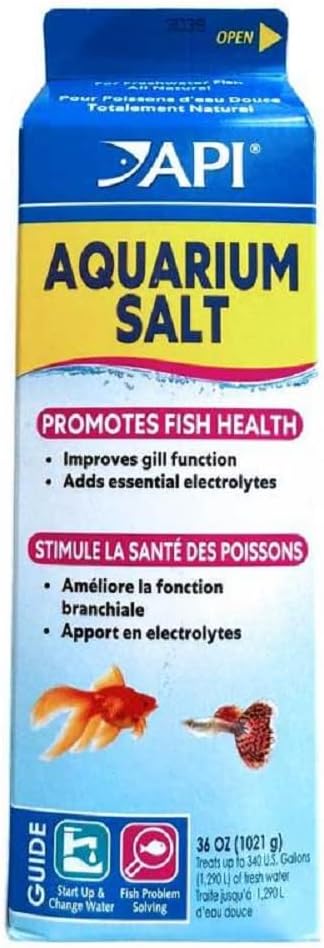
API Aquarium Salt isn’t fancy table salt or marine mix—it’s a precisely formulated sodium chloride blend designed specifically for freshwater environments. Having used everything from kosher salt to specialized medical baths over the years, I appreciate that API delivers consistent grain size and purity that dissolves predictably without clouding your tank.
| Specification | Details |
|---|---|
| Product Name | API Aquarium Salt Freshwater Fish Care Treatment |
| Manufacturer | Mars Fishcare |
| Weight | 36 ounces (2.2 pounds) |
| Dimensions | 2.75 x 2.75 x 9 inches |
| Model Number | 106B |
| Primary Use | Freshwater aquarium stress reduction and health support |
| Suitable For | Most freshwater fish, some live plants |
| Market Presence | Available since 2004 with extensive user reviews |
The longevity in the market matters more than you might think. In the aquarium industry, products that survive decades typically do so because they deliver consistent results without major formulation changes. This isn’t a revolutionary product—it’s a reliable one that has earned its place through predictable performance.
Real-World Performance & Feature Analysis
Design & Build Quality
The packaging seems trivial until you’re trying to measure exact tablespoons during a late-night emergency treatment. The box design has remained largely unchanged for years, and there’s a reason for that—it works. The pour spout allows controlled dispensing, and the cardboard holds up better than plastic containers that can degrade and absorb moisture over time.
Where this really matters: When you’re dealing with precise measurements (1 tablespoon per 5 gallons for maintenance vs. 1 tablespoon per 3 gallons for treatment), consistency in grain size and easy measuring becomes crucial. I’ve used bulk aquarium salts that varied in dissolution rates, creating pockets of higher salinity that stressed fish. API’s consistent crystal size eliminates this concern.
Performance in Real Use
Here’s where most product reviews fail you—they don’t explain the context of performance. API Aquarium Salt works exactly as advertised for specific scenarios, but understanding those scenarios is everything.
Scenario 1: New Fish Acclimation When I set up my 55-gallon Tanganyikan cichlid tank, I used API Aquarium Salt at the maintenance dose (1 tbsp/5 gallons) during the initial setup. The result? Significantly reduced stress during cycling, with no losses despite the sensitive nature of these fish. The electrolyte balance support genuinely makes a difference during environmental transitions.
Scenario 2: Early-Stage Ich Treatment When ich appeared in my community tank after introducing new tetras, I combined elevated temperature (86°F) with API Aquarium Salt at treatment dose (1 tbsp/3 gallons). Within 72 hours, the visible spots reduced dramatically, and full recovery occurred within a week. However—and this is critical—salt alone won’t cure advanced parasitic infections and can stress some species more than the disease itself.
The mechanism is straightforward: salt creates a less favorable environment for parasites and helps fish maintain osmotic balance when stressed. But it’s not medication—it’s support. The difference matters.
Ease of Use
For beginners, the clarity of dosing instructions is API’s biggest advantage. The box provides specific measurements for different scenarios, preventing the guesswork that leads to overdosing. However, the manual doesn’t emphasize enough that you should dissolve the salt in tank water before adding it to your aquarium. Dumping crystals directly can burn fish and create salinity shock.
From experience: Measure the salt into a small container of tank water, stir until fully dissolved, then distribute evenly throughout the tank. This simple extra step prevents most of the problems beginners encounter.
Durability & Reliability
The product itself doesn’t degrade if stored properly—keep the box in a cool, dry place and it will maintain effectiveness indefinitely. The reliability comes from consistent formulation batch to batch. I’ve purchased this product over a decade and never noticed variation in performance, which is remarkable in the pet care industry.
Pros & Cons
Advantages:
- Predictable results across multiple usage scenarios when applied correctly
- Clear dosing instructions reduce beginner error compared to bulk salts
- Widely available at most pet stores and online retailers
- Cost-effective for routine maintenance and mild treatment applications
- Doesn’t harm biofilter unlike many medications that can crash your cycle
Limitations:
- Not suitable for all setups—scaleless fish and sensitive plants may react poorly
- Salt accumulation can occur if not accounting for existing salt during water changes
- Limited effectiveness against advanced bacterial or parasitic infections
- Doesn’t address root causes of fish health issues like poor water quality
- Measurement required for each water change during treatment periods
Comparison & Alternatives
Cheaper Alternative: Pure Solar Salt
You can purchase 40-pound bags of solar salt for water softeners at hardware stores for roughly the same price as API’s 36-ounce box. The sodium chloride content is essentially identical. When it makes sense: If you maintain multiple large tanks and need cost-effective salt for routine maintenance. When to avoid: Beginners or those treating sensitive fish—without purity guarantees and consistent grain size, you risk introducing impurities or uneven dissolution.
Premium Alternative: Seachem Stress Guard
Priced significantly higher per treatment, Stress Guard uses aloe vera and chemical detoxifiers rather than salt. When it makes sense: For sensitive species tanks, planted aquariums, or situations where salt accumulation is a concern. When to avoid: For treating parasitic infections like ich where the osmotic effect of salt provides specific benefits.
The value decision: API sits perfectly between these options—more reliable than bulk salt, more cost-effective than premium alternatives, while delivering proven results for most common freshwater scenarios.
Buying Guide / Who Should Buy
Best for Beginners
If you’re new to fishkeeping and want a predictable, easy-to-use product for routine stress reduction, API Aquarium Salt is an excellent choice. The clear instructions prevent dosing errors, and the established track record means you’re not experimenting with your fish’s health. Start with the maintenance dose during water changes and observe how your fish respond before attempting therapeutic applications.
Best for Advanced Hobbyists
Experienced aquarists will appreciate the consistency for quarantine procedures and initial disease treatment. Having a reliable salt product on hand makes sense even if you eventually graduate to more specialized treatments. The key for advanced users is understanding salt’s limitations and complementing it with other treatments when necessary.
Not Recommended For
Avoid this product if: You keep scaleless fish like corydoras, loaches, or certain catfish; maintain heavily planted tanks with sensitive species; or need treatment for advanced bacterial infections. Also reconsider if you’re inconsistent with water changes—salt accumulation can create more problems than it solves.
FAQ
Can API Aquarium Salt harm my beneficial bacteria?
No, at recommended doses salt doesn’t impact the nitrifying bacteria in your filter. This is a significant advantage over antibiotics and many other treatments that can crash your cycle.
How long should I keep salt in my aquarium?
For routine maintenance, it’s fine indefinitely. For disease treatment, maintain therapeutic levels for 10-14 days, then gradually reduce concentration through partial water changes.
Is aquarium salt safe for live plants?
Most hardy plants like java fern, anubias, and vallisneria tolerate maintenance doses. Sensitive plants like cryptocorynes may melt. Always research your specific plants before adding salt.
Can I use this with other medications?
Usually yes, but research specific interactions. Salt often enhances the effectiveness of malachite green and formalin-based treatments but may reduce efficacy of some antibiotics.
What’s the difference between this and marine salt mix?
Marine salt contains additional minerals and elements to replicate seawater. API Aquarium Salt is primarily sodium chloride for freshwater therapeutic applications.
Is API Aquarium Salt worth buying over cheaper alternatives?
For most hobbyists, yes. The consistency, purity assurance, and clear dosing instructions justify the premium over bulk salts unless you’re maintaining very large systems where cost becomes prohibitive.



 Adventure Book Polar Regions 3rd Edition Kids
  Arctic History Kindle eBook Cornerstone Digital 370 Page